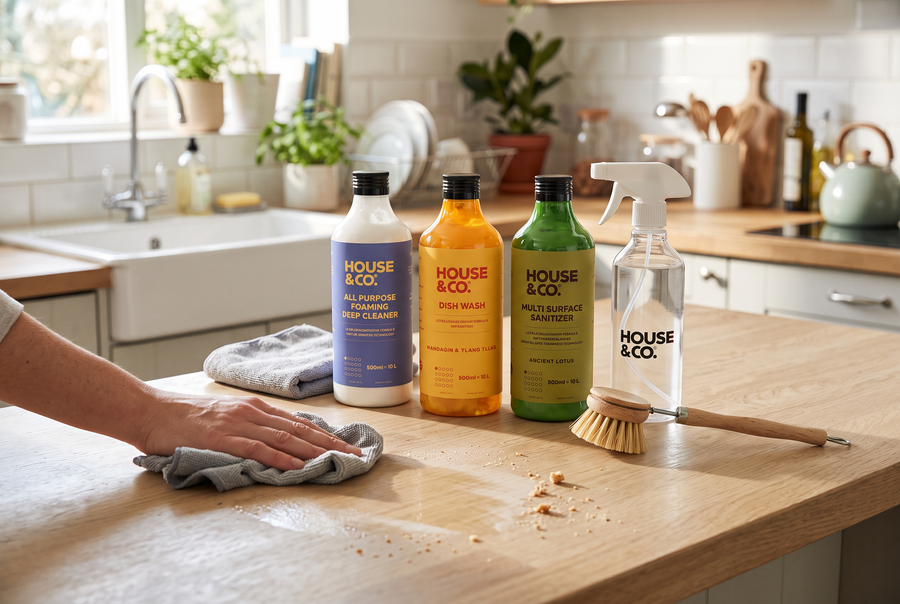
What ultra-concentrated means. The 24 ml rule.
· 3 min read · House & Co.
Turn any of our bottles around and the label says the same thing: 500 ml = 10 L. It is the most important line on the bottle and the one people trust least, because it sounds like marketing. It is not. It is the dilution ratio, and once you understand it, you will never pour a cleaner straight from the bottle again.
What is actually in a cleaner
A cleaner has two jobs: loosen the dirt and carry it away. The loosening is done by surfactants, molecules with one end that likes water and one end that likes oil. They sit on the grease, pull it off the surface and wrap it so water can rinse it away. In a dish wash, a floor cleaner or a surface spray, the surfactants, the enzymes and the scent are a small fraction of the liquid. The rest is water, there to make the product thin enough to pour and cheap enough to seem generous.
A ready-to-use spray is typically 90 to 95 percent water. A concentrate is the same active ingredients with the water left out. Our formulas are built to be diluted: the surfactant load is twenty times a supermarket spray, the enzymes are stabilised so they survive on a shelf, and the scent is dosed for the diluted strength, not the bottle. Which is why a concentrate smells strong in the bottle and right in the refill.

The label is the measure
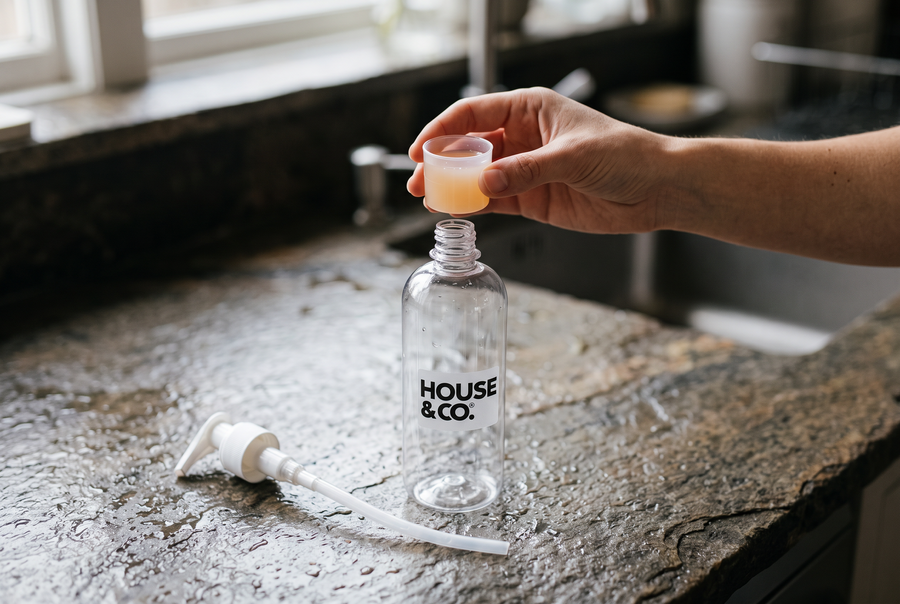
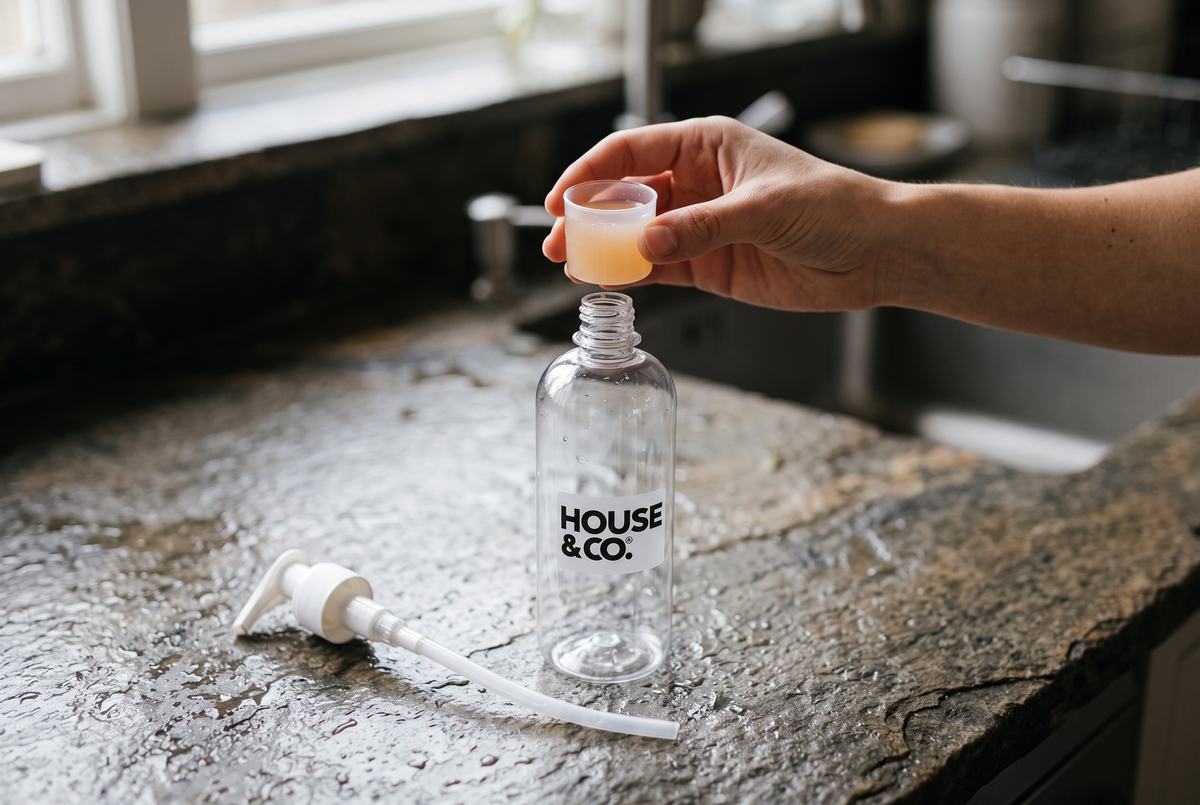
Every label carries its dose: 24 ml into the 500 ml refill bottle for the cleaners and the Air Freshener, then water up to 476 ml. Pour, top up to the shoulder, done. You do not need a measuring jug and you do not need to be exact: 22 ml or 28 ml both make a cleaner that works. What you should not do is guess by eye from the bottle, because a glug is usually 60 ml and that is three refills poured into one.
The hand and body washes are the exception. They are richer, and they foam, so the mix is one part to eight: 22 ml in the 200 ml foamer bottle, up to the line printed on it, then water. A 500 ml hand wash concentrate makes 4 litres of foam wash, not 10, and the label says so. The Odour Neutraliser is the other exception, at one part in six: 83 ml to 417 ml of water.
Why more is not better
It is tempting to add a second dose for a dirty job. It does not help. Surfactants work at the surface of the water, and once there are enough of them to cover it, extra ones just float around unused. A stronger mix leaves more residue behind, and residue is sticky: it holds dust, it streaks glass and it makes a floor look dull a day after you cleaned it. For a hard job, the answer is time, not dose. Spray, wait a minute, then wipe.

How long one bottle lasts your home
At one refill a month, a concentrate lasts about a year and a half. Most homes use dish wash faster than that and floor cleaner slower. If you want the real number for your kitchen, the bottle calculator works it out from how many refills you get through, and tells you which concentrates to put in the box. The refill bottle comes free with each one; the dose is on the label in your hand.